Login
LoginBlog
Yuzu vs Attio: AI CRM flexibility vs outcome-changing moves
Attio gives teams a modern data model for revenue. Yuzu reads the live deal and produces the action.

Short answer: Attio and Yuzu are solving different layers of the revenue stack. Attio is strongest as an AI-native CRM or GTM workspace. Yuzu is the GTM action layer that reads the live deal, decides whether the moment matters, and helps the seller send the move.
What the public Attio UI showsLink to heading
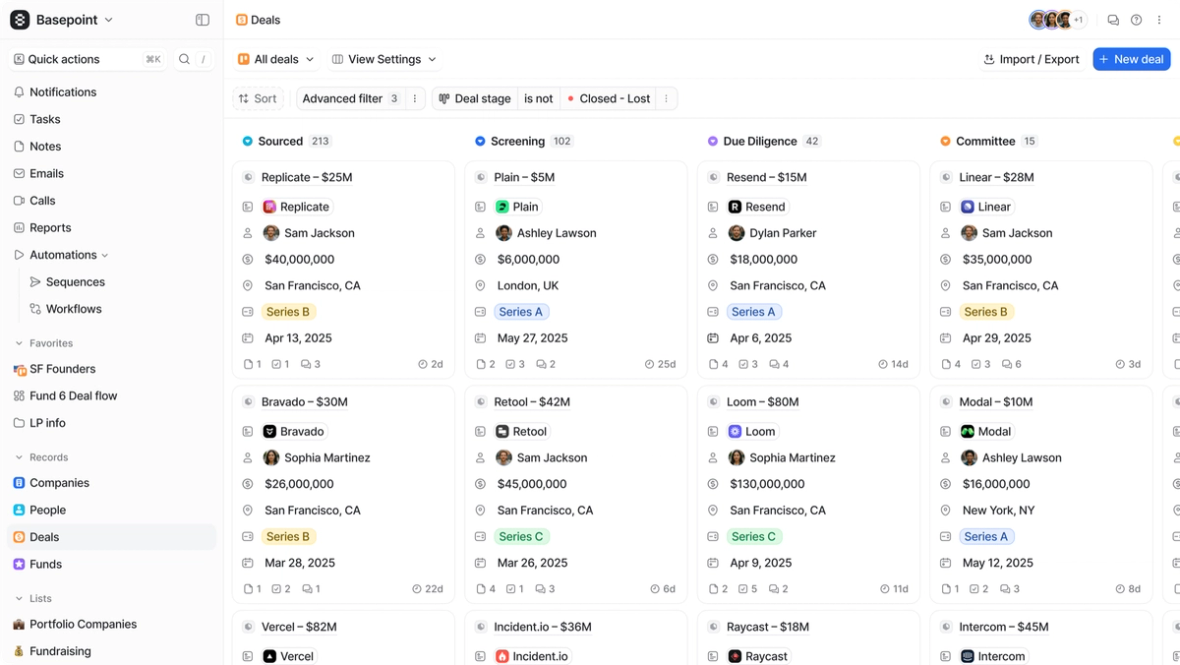
The Attio reference screenshot shows a deals kanban built from a flexible data model. It is not trying to look like an old CRM. The emphasis is on objects, lists, views, relationships, and the ability to shape the workspace around the way the company actually sells.
Attio is strongest for teams that want CRM flexibility. If the company needs custom objects, relationship-rich records, configurable lists, automations, and a more modern interface than a legacy CRM, Attio is a compelling system to build around.
What Yuzu is solving beside AttioLink to heading
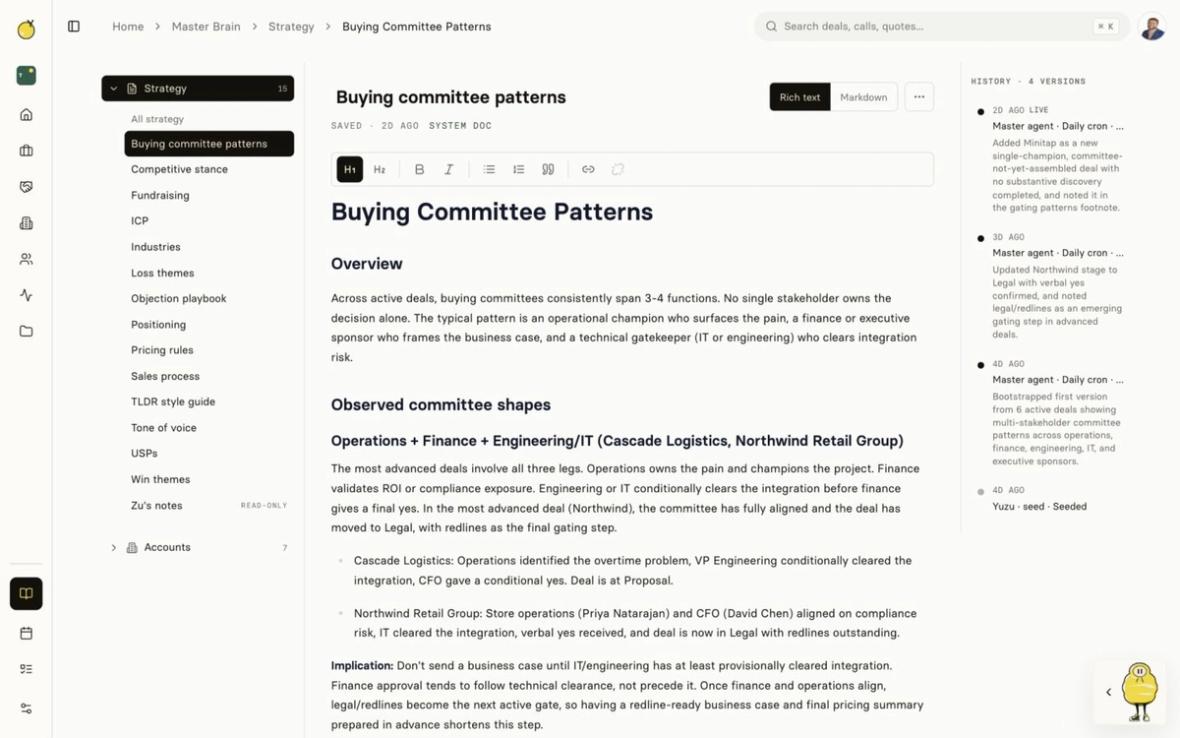
Yuzu is not competing to be the customizable database. We care about the live revenue moment inside and around that database. The deal has a shape: who believes, who is silent, what proof is missing, what similar wins looked like, and whether the current path is drifting away from the one that usually closes.
Yuzu’s Master Brain and Vault make the difference visible. Calls, notes, pricing objections, stakeholder beliefs, and closed-won patterns are not just records. They become the context for a read and a move. The seller gets a drafted artifact or next step, not only a cleaner object model.
Capability check: Attio vs Yuzu
| Feature | Attio | Yuzu |
|---|---|---|
| Official CRM record | ||
| Forecast timing | ||
| Call / meeting capture | ||
| Ranks what changed | ||
| Buyer-facing TLDR video | ||
| Business proof page | ||
| Seller follow-up draft | ||
| CRM writeback after approval |
Feature details: Attio vs Yuzu
| Feature | Attio | Yuzu |
|---|---|---|
| Data model | Flexible objects, lists, views, relationships, and CRM workflow design. | Reads whatever model the team already uses, then connects it to call and buyer signals. |
| Live deal read | Depends on the records, views, fields, and automations the team creates. | Built around weighted signals from calls, CRM, email silence, stakeholder change, and prior wins. |
| Knowledge memory | A modern CRM record can keep rich context if the team models it. | Master Brain and Vault keep GTM-specific patterns, objections, win themes, and deal memory alive. |
| Action output | Workflow automation and CRM actions when configured. | Seller-reviewed TLDR, business page, follow-up, route, or CRM writeback. |
| Best buyer | Teams that want a better CRM foundation. | Teams that already have context and want the next move to be generated from it. |
What teams usually misunderstandLink to heading
The common mistake is treating every revenue product as if it competes in the same category. Attio may be excellent at its primary job and still leave a gap that Yuzu is built to fill. A CRM can be clean and a deal can still stall. A call can be perfectly transcribed and still never become buyer proof. A forecast view can show the risk and still not change the outcome.
That is why the comparison should not start with a replacement question. It should start with the workflow. What happens after the call? What happens when the champion goes quiet? What happens when legal enters late? What happens when the buyer needs a CFO-ready explanation but the seller has only notes and a deck?
Yuzu is for the part of the workflow where the team already has enough raw information but not enough converted action. The value is not another place to look. The value is a concrete move that can be reviewed, sent, and written back into the system the team already trusts.
Buying criteria: Attio or Yuzu?
| Feature | Attio | Yuzu |
|---|---|---|
| If you are buying for record quality | Attio may be the primary system when the goal is to improve where information is stored, searched, reported, or reviewed. | Yuzu is usually not the primary system for record quality. It reads the record and gives the team a move worth making. |
| If you are buying for forecast confidence | Attio can help depending on whether it owns the CRM record, call intelligence, or meeting history that feeds the forecast process. | Yuzu helps when forecast confidence depends on buyer behavior, proof gaps, stakeholder drift, and the timing of one action. |
| If you are buying for seller time | Attio can reduce admin or improve inspection, but the seller may still need to write the follow-up, recap, or business case manually. | Yuzu is designed to turn captured context into the draft itself, then let the seller approve, edit, and send. |
| If you are buying for buyer enablement | Attio can help hold context, but it is not primarily a buyer-facing proof factory. | Yuzu turns the call into buyer-ready artifacts: TLDR videos, business pages, champion notes, and mutual action plans. |
| If you are buying for stack simplicity | Attio should be evaluated on whether it replaces an existing workflow or makes the existing workflow easier to operate. | Yuzu should be evaluated on whether it reduces the time between signal and action without asking the team to migrate the stack. |
Where Attio is still the right choiceLink to heading
Use Attio when the team wants a flexible, modern CRM foundation. It is especially useful when the default CRM schema does not match the business and the team wants to model accounts, companies, people, relationships, and workflows with more control.
A good evaluation should respect that. If the current pain is adoption, data structure, meeting capture, account scoring, manager inspection, or workspace hygiene, Attio may be closer to the primary purchase. Yuzu should not be bought to solve a storage problem. It should be bought when storage and capture already exist, but the team still misses the moment.
Where the gap opensLink to heading
The gap opens when better data design still leaves the seller doing the strategic work alone. A kanban can show stage movement. A custom object can capture a relationship. But the team still has to decide whether the legal stakeholder matters, whether the champion needs proof, and what to send this week.
In most revenue teams, the gap appears in the same place: mid-funnel. The team has notes from the call, a CRM stage, a next step, maybe a recorded conversation, and some internal Slack commentary. The hard part is not remembering the facts. The hard part is deciding which fact matters enough to interrupt the seller and what artifact the buyer should receive.
That is the difference between intelligence and action. Intelligence tells you something is true. Action changes what the buyer can do next. Yuzu is intentionally biased toward the action.
Workflow exampleLink to heading
A team can keep Attio as the CRM and let Yuzu read across the objects and call data. When a deal starts to resemble a prior lost pattern, Yuzu explains the signal and drafts the next move. The clean CRM model remains useful, but the seller does not have to translate every signal by hand.
The practical test is simple: after a call, can the team go from buyer language to buyer proof without a manual scramble? If the answer is no, then Attio is not necessarily failing. It may be doing its job. The missing layer is the one that reads the moment, drafts the proof, and keeps the official system updated after the seller approves it.
What to verify in a pilotLink to heading
Run the pilot on real deals, not dummy data. Keep Attio in the workflow and ask whether Yuzu reduces the time from signal to action. Pick five mid-funnel opportunities with calls, CRM history, and some buyer ambiguity. Then measure whether Yuzu can explain what changed, identify the stakeholder or proof gap, and produce an artifact the seller is willing to send.
The strongest pilot metric is not model novelty. It is seller adoption. Did the seller trust the read? Did they approve the draft? Did the champion receive something more useful than another generic follow-up? Did the CRM or workspace end up cleaner after the move rather than messier?
The second metric is buyer usefulness. A TLDR video, business page, or champion note should make the buyer better at selling internally. If the artifact only impresses the vendor side, it is not doing the job. The buyer should be able to forward it, quote it, or bring it into an internal meeting.
How to use Yuzu with AttioLink to heading
Attio and Yuzu are strongest together when the team wants a modern CRM plus deal intelligence that turns context into action. Attio models the business. Yuzu helps move the buyer.
The cleanest implementation is layered. Keep Attio where it is strongest. Let Yuzu listen to the signals around it. When Yuzu acts, the output should return to the operating system as a link, note, risk read, task, or next step. That keeps the team from creating another disconnected place to check.
The operational test
If the question is “where should the record live?”, Attio may be the answer. If the question is “what should the seller do now, and what proof should the buyer receive?”, that is the Yuzu question. The difference matters because revenue teams already have more records, notes, and dashboards than they can act on.
See this product in context on the Attio column of the Yuzu comparison page.
Sources and screenshot noteLink to heading
The Attio UI screenshot above was captured from public product or documentation material from Attio Help. The Yuzu screenshots are live product surfaces from the Tempo sandbox in app.yuzulabs.io, captured from Master Brain, deals, and buyer artifact review views.
Book a demoLink to heading
If your team already has the CRM, notes, and calls, but still loses time deciding which move should happen next, book a Yuzu demo. We will show how Yuzu reads real deals, creates buyer-ready proof, and writes the action back into the tools you already use.